|
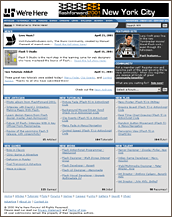
were-here.com |

urban couple collage |

old country collage |

claudia & claire e-commerce system from
Flash MX: Application Design & Development
|
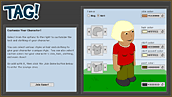
multi-player tag game from Flash MX: Application
Design & Development |
 |
|
The first name
that usually comes to mind when discussing women
who work with Flash is renowned designer, coder
and author Jessica Speigel.
Jessica is co-founder of We’re Here Forums,
an incredible resource community with over 50,000
members and receives upwards of 8 million visitors
per month. Jessica has been referred to as “a
hub in the Flash design community”. |
How do you explain the
amazing success and popularity of Were-Here?
You and Aaron have created an environment where
thousands of people connect daily. What do you
think you’ve done at Were-Here.com that
has made your forum such a success and kept
it that way? |
|
Well, it’s hard to put my finger on just
one thing. I think a lot of it had to do with
being in the right place at the right time in
the beginning, but I think what kept the wheel
turning was how Aaron and I chose to run the community.
We always tried to foster a supportive community
where helpful, kind people were elevated to moderator
status, rather than choosing moderators based
on their name or reputation alone. We also don’t
put up with abusive behavior. It’s so important
when building a community to create an atmosphere
where members feel safe to share their thoughts
without fear that someone will come along, throwing
around insults indiscriminately, and have nothing
done about it. I think that’s why we can
manage to have political and religious conversations
with people from all over the world with extremely
different views successfully. People know that
threads like that are welcome, as long as they
don’t become abusive, so people share their
thoughts in a much more constructive manner.
That being said, I try and always take into
consideration a person's intentions (as much
as I can know anyways) when sizing up their
actions or words, before and after the fact.
I also don't always take into account a person's
reputation, because any event can be twisted
around to sound bad or good, depending on the
description and the person doing the describing;
and most importantly mistakes are a part of
life. Not giving a person another chance to
do right is the real mistake you can make. Aaron
and I always kept that in mind when it came
to the were-here community. People were banned
at times when they clearly violated the rules;
abusing other members, posting inappropriate
material, etc. However, a person that contacted
us to explain himself is never refused a second
chance. A third chance would be pushing it,
but it did happen, depending on the situation.
99% of the time, the people who were given another
chance never repeated the original behaviour
and went on to become very valuable members
of the community.
The most important thing is to treat people
fairly. |
| When
you launched the site in 1999, did you ever expect
it to grow to the enormous capacity it has? Could
you give us a little history of how it began? |
| Really, if you had asked me this question three
years, eight months ago, I would have laughed.
I never expected or intended for the site to grow
as it did. Originally, Aaron registered the were-here.com
domain name as a personal site. At the time he
registered the domain, we were both members of
the Flashpad community at flasher.net. After we
had been members there for about a year, the site
suddenly went down and never came back online.
It happened that Aaron was testing out bulletin
board software for a client when that went on,
so we decided to create a small resource site.
I wrote a bunch of tutorials, based mostly on
the questions I answered most frequently on Flashpad.
The people we interacted with on Flashpad started
migrating over and the rest is history! I must
say that I kind of miss the old days though. I
enjoyed the days where I could personally answer
every question posted to the forums. |
| What
inspired you to create this site? |
| I know this sounds suspiciously wholesome, but
I really just wanted to help people just getting
into the industry. I started my career through
the community. I learned everything I know online
from resource sites and made contact with potential
employers in the same fashion. It was important
to me to give back to the community that had helped
me get started. It’s so nice to see someone
that’s been helped through the community
make it and then make the shift from student to
teacher. It’s a great process of learning
and sharing the gained knowledge. |
| The
site had some down time. What happened? |
| Aaron and I had some personal as well as financial
problems. We were in the middle of moving hosts
and kept our account active with the current host
while the new server was being set up, but the
new host never could get our server set up to
spec, and we double paid for a couple months.
Then we got er in a different
light than themselves, but really both groups
are exceptionally creative. I remember when Flash
4 introduced ActionScript, and there was a huge
buzz among the community pitting programmers against
designers, asking who was going to win. I think
we’re going to see a lot of really well-rounded
people come out of this industry and Flash continues
to progress. |
| Do
your technical abilities give you greater control
over your Flash design? If so does this help you
achieve the results you’re aiming for? |
| I believe so. Really, what’s helped me
the most is knowing exactly what Flash can and
can’t do. I know it sounds weird, but knowing
the limits expands my creativity so much. That’s
the kind of person I am, give me a rule and I
will automatically figure out a way around it.
It’s just the way my brain works. |
| Who
has been your artistic inspiration in your professional
work? |
| It’s so hard to name just one! Todd
Purgason (http://www.juxtinteractive.com)
has always influenced my style. Additionally,
Christine Smart (http://www.beingsmart.com)
has always inspired me with her artwork and all
around craftiness. I also love Jenny Dean’s
(http://www.visualade.com)
style, it’s so minimalist and fun! There
are so many people doing such amazing things with
Flash right now. I don’t think I could name
them all if I tried! |
| Name
the first five non-Flash related things that enter
your mind, and tell us a bit about each. |
Science – Been doing
a lot of thinking about science recently. Especially
quantum theory. I’m reading this great
book right now that speculates about how free
will could be proven via quantum phenomena.
It also goes into quantum processes in the brain
and how God could work in the world through
quantum uncertainty while not breaking the laws
of nature.
Religion – Been doing
a bunch of research on Judaism lately. I was
raised in a religious household, but kind of
left it behind as I grew older. I’ve been
trying to get back to my heritage and learn
about my tradition. I’m even learning
Hebrew again. I was almost fluent when I was
younger, since I started learning it in preschool,
but I’ve forgotten a lot of it over the
years. I remember the alphabet and how to read
it, but not a lot of the grammar and syntax
anymore. I can understand a few words here and
there, but not anywhere close to where I used
to be. It’s such a beautiful language
too and it would be a shame to not relearn it.
Education – I really
want to go back to school and get my degree.
I’ve been thinking about it for a long
time now, and I’ve decided that it’s
time. I really want to finish up as much schooling
as I can before I settle down and have a family
(even though that’s a long way off). Now
I just have to figure out what I’m going
to study!
Meaning & Consciousness
– I know that’s kind of an abstract
thing to say, but I’ve been wondering
how human consciousness interprets and seeks
out meaning in different things, language in
particular. I remember when I was a little girl,
I was baffled by the fact that I couldn’t
look at something that was written without reading
and understanding it. I would try to remember
how the characters looked before I learned how
to read to no avail. It’s really interesting
to me how a mind will seek out meaning in the
smallest things and relate them to the person’s
experience. It seems as though human consciousness
is hardwired to seek out meaning. To me, that
proves the existence of a higher consciousness.
Maybe that ties into spirituality, but I’m
really in awe of the entire process. When you
see meaning in everything, there’s no
way to be unhappy with life.
Interior design – My
walls are hospital white and none of my furniture
matches, enough said! |
| Being
self-taught, do you have any advice or tips you
could give to those starting to learn Flash? |
| Get involved in the community! Ask a question
when you’re confused, but more importantly,
try and answer all the questions you can. I’ve
always found that teaching others is a wonderful
way to learn yourself! Besides, it gets you karma
points. Learn from what others have done in the
past, and try to improve on their work. There’s
no reason to rebuild the wheel, but things can
always be improved. Share your source when you’re
done so others can benefit from your learning
process. Last but not least, RTFM cover to cover
before you begin. It doesn’t matter if it
doesn’t make sense or sink in right away.
It’s not really important that you understand
it the first time around, but rather that it’s
in the back of your head when you’re working
with Flash, and you’ll remember vaguely
reading something that relates to what you’re
doing and be able to find it in the help later. |
| It’s
fantastic that a woman in her twenties has accomplished
so much! What’s next for Jessica? |
| In the immediate future, I’m doing a big
contract job for Microsoft that I’m super
excited about. Going to be working with the team
that makes my favorite piece of MS software, Encarta
Encyclopedia! That should be a lot of fun! I’ll
be saving my pennies and getting back into the
classroom after that! |
| If
you could say one thing to the goddesses out there,
what would it be? |
| Keep on truckin’! It’s so important
to have a big, representative group of all the
Flash babes out there so when a little girl says
to her mom, “Mommy, when I grow up I want
to make things move!” Her mom can look to
the FlashGoddess site and show her how many female
Flash developers and designers are out there to
inspire her to be great. There should be no reason
for a girl to think that only boys are smart enough
to do all the “confusing” technical
things. Smart is sexy! |
Thank you Jessica for
taking the time out for the interview and for your
invaluable contribution to the Flash community!
And thanks to the Flash
Goddess members who assisted me in compiling the questions,
CHILL, Galaxygoo, Kim, Kristin and Warangel!
|